
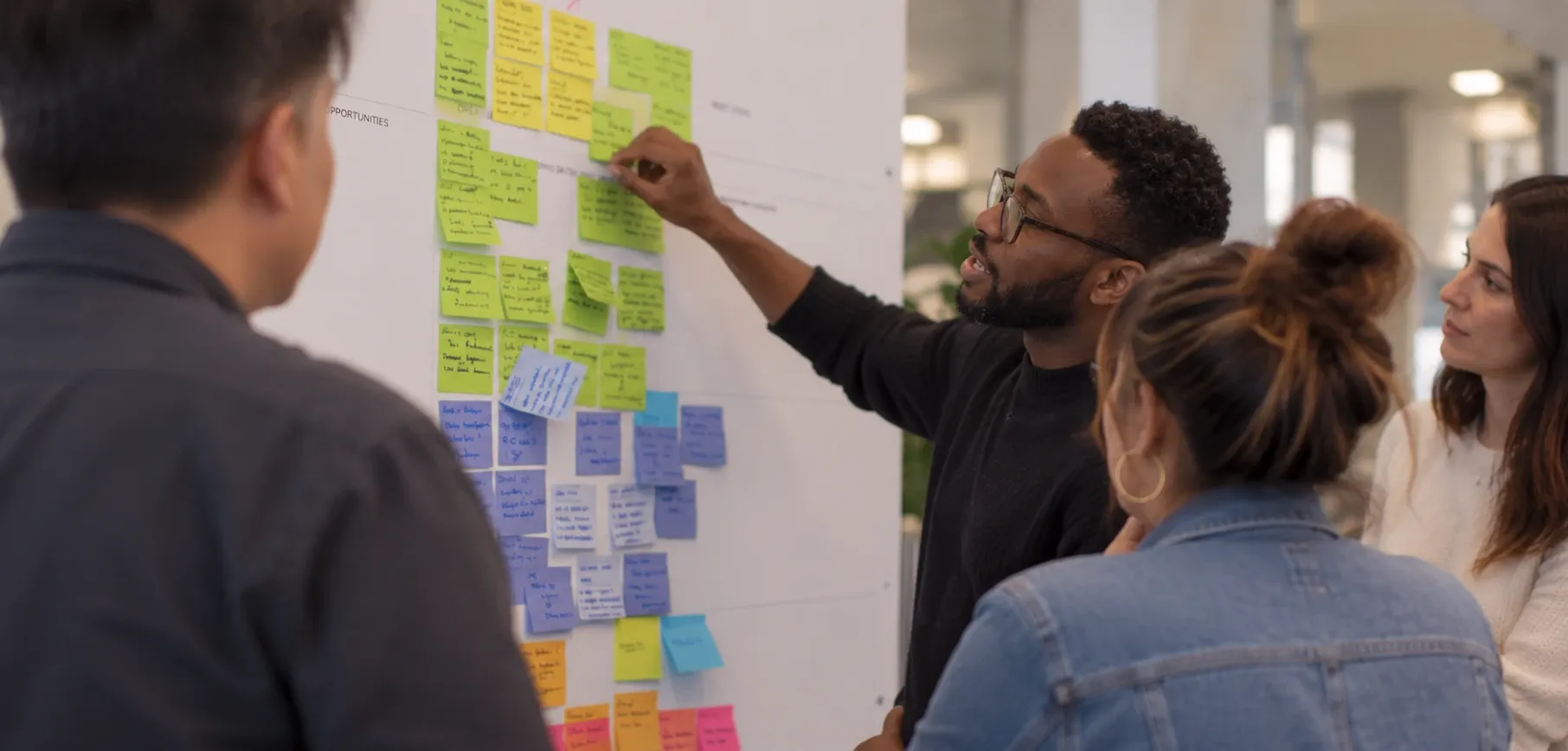
Our approach
Better tools don't automatically make better work.
AI changes what's possible. Getting the most out of it means learning new skills, questioning old assumptions, and rethinking how we work.
Our principles
-
Learn when to question AI.
AI recognizes patterns, not necessarily truth. Learn to spot mistakes, recognize bias, and know when to dig deeper.
-
Keep people in control.
Direct AI, challenge its reasoning, and build checkpoints into workflows so people remain responsible for important decisions.
-
Make AI work in your voice.
Teach AI your style, preferences, and ways of thinking so the work reflects your expertise rather than sounding like everyone else's.
-
Make your best work repeatable.
Turn successful approaches into reusable AI skills and workflows that capture what works and improve over time.
What this means for your team: People learn to question AI, make better decisions, preserve their expertise, and turn successful approaches into repeatable ways of working.
There's more to AI than asking questions.
We teach teams six practical ways to work with AI. Knowing which mode to use, how to guide it, and when to switch helps people get better results across different tools, tasks, and roles.
Search Engine
Get oriented quickly. Know what to verify.
- When to use it
- When you need a quick understanding of an unfamiliar topic, existing information, or different perspectives.
- How to use it better
- Use AI to identify the important questions, compare viewpoints, and find where to investigate further.
- Try asking
- “What are the main schools of thought here, and how do they differ?”
- Watch out for
- Confident answers aren't necessarily correct. Treat summaries as starting points, not verified truth.
Mode switching in action
- Gather context An assistant that searches the web Search Engine
- Plan A model that shapes the approach Thinking Partner
- Build A model that does the work Content Generator
- Cross-check A second model reviews the first Specialist Stand-In
- Decide A person makes the call Human judgment
-
Turn the workflow into a reusable skill.
This illustrates the System / Operating Layer.
Mode switching is the skill. Not prompting. Not the tool.
The result: Your team learns how to approach complex work with AI, combine different capabilities, and keep human judgment at the center.
Explore AI FoundationsHow we help your team put AI to work.
We bring practical AI experience. Your team brings its knowledge, challenges, and ideas. Together, we identify opportunities, build skills, apply AI to real work, and develop better ways of working.
-
Discover
Find out how people work today, where AI is already helping, and where new opportunities exist.
-
Enable
Give people the knowledge, confidence, and skills to start working differently with AI.
-
Apply
Put new skills to work. Co-create solutions, test them on real challenges, and discover what works.
-
Reinforce
Keep learning, sharing, and improving as new capabilities take hold.
Frequently asked questions.
What are the six AI working modes?
The six AI working modes are Search Engine, Thinking Partner, Content Generator, Specialist Stand-In, Productivity Assistant, and System / Operating Layer. Each represents a different way to work with AI, from finding information and challenging ideas to creating content and building repeatable systems. The skill is knowing which mode to use, how to guide it, and when to switch.
How can employees use AI without losing their judgment or voice?
People get more from AI when they guide it, question its output, and bring their own expertise into the process. We teach teams how to use AI as a thinking partner, challenge assumptions, preserve their voice, and recognize when human judgment matters most. The goal is to make people better at their work, not replace their thinking.
How do you identify where AI can improve our workflows?
We start by understanding how the work actually happens. That means talking with teams, observing workflows, and identifying the tasks, decisions, and challenges where AI could make a difference. Then we co-create and test approaches together, learn what works, and turn successful approaches into repeatable practices.
What makes an organizational AI adoption program successful?
Successful AI adoption happens when people have the skills, confidence, and support to use AI in real work. Training creates a foundation, but practice, coaching, shared learning, and leadership support help new habits take hold. That's why our approach combines hands-on learning with ongoing improvement.
How do you address responsible AI use, bias, and accuracy?
We teach teams to question AI, not simply trust its answers. That includes recognizing limitations, spotting bias, checking accuracy, and building appropriate human review into workflows. Responsible AI use isn't a separate lesson. It's part of how we teach people to work with the technology.
Let's explore what's possible.
Curious about what AI could do for your team? Let's have a conversation and see where it takes us.
Let's Talk