
Insights · Case study · Built in Practice
From Interviews to Recruiting Intelligence
How we redesigned recruiting around AI to capture deeper candidate insights, improve consistency, and give recruiters more time to focus on people.

Recruiting is built on conversations.
An experienced recruiter learns far more from an interview than what’s written on a resume. They uncover technical experience, understand career goals, assess communication skills, and develop a sense of where someone might succeed.
But much of that valuable information gets lost in the administrative process.
Recruiters spend time taking notes, updating candidate records, summarizing qualifications, and preparing information for hiring managers. Important details can be missed, and the quality of documentation often depends on the individual recruiter.
At Riva Ops, we saw an opportunity to rethink the process.
What if we could capture more of what makes a candidate valuable, while giving recruiters more time to focus on the conversation itself?
Rethinking the recruiting process
We didn’t approach AI as a tool for automatically screening or replacing recruiters.
We started with a different question: How could we make our recruiters more effective while preserving the human judgment that makes recruiting work?
Our approach combines structured interviews, AI-assisted conversation capture, consistent evaluation criteria, and connected recruiting systems.
The goal is to create richer candidate intelligence that becomes more useful throughout the recruiting lifecycle.
And just as importantly, to help recruiters continuously improve their own interviewing and evaluation skills.
What we built
Recruiting intelligence workflow
From Interviews to Recruiting Intelligence
A connected recruiting workflow that captures richer candidate insight, streamlines evaluation, and helps recruiters keep improving.
- 01 Interview Structured, role-specific interviews capture deeper candidate insight, recorded with consent.
- 02 Extract AI turns the conversation into structured skills, experience, qualifications, and preferences.
- 03 Evaluate Role-specific criteria and an initial AI assessment, reviewed and adjusted by the recruiter.
- 04 Organize Consistent profiles flow into our ATS and searchable candidate rosters.
- 05 Match Recruiters connect candidate capabilities to open roles and client needs.
- 06 Improve AI coaching flags missed questions and refines interview guides and skills.
A continuous improvement loop: every interview sharpens the guides, the criteria, and the next conversation.
The result
From 30–60 min to 5–10 min Post-interview administration per candidate
~83% Less admin time, measured across 30–40 candidates
- Richer, more consistent candidate profiles
- A stronger recruiting process that keeps improving
1. Better conversations, richer information
Better conversations start before the interview. AI analyzes candidate profiles, resumes, and applications to draft personalized outreach across email, text, voicemail, and live calls. Recruiters review, edit, and send each message without starting from scratch.
We developed structured interview guides tailored to the roles we’re recruiting for, including electricians and low-voltage technicians.
With candidate consent, interviews can be recorded and analyzed, allowing recruiters to focus more fully on the conversation rather than dividing their attention between listening and taking notes.
AI helps identify relevant technical experience, qualifications, career preferences, and details that deserve further exploration.
The result is a more complete picture of each candidate.
2. From conversation to structured candidate intelligence
Rather than manually translating every interview into database fields, we use AI to extract and organize relevant information.
Trade experience, technical skills, qualifications, and other important details are structured for use in our ATS.
This creates more consistent candidate records and makes the information easier to find, compare, and use when matching people to opportunities.
The objective isn’t simply faster data entry.
It’s better information that remains useful long after the interview ends.
3. Consistent evaluation, with human judgment
We’ve developed role-specific evaluation frameworks to help assess candidates against relevant criteria.
AI supports the process by organizing evidence from interviews and highlighting areas for review.
Recruiters can examine, challenge, and adjust those assessments rather than treating an AI-generated rating as a final decision.
This gives us a more consistent starting point while keeping accountability with the people making hiring decisions.
4. Making candidate intelligence accessible
We also developed searchable, Riva-branded candidate rosters that organize information for recruiting, sales, and client-facing workflows.
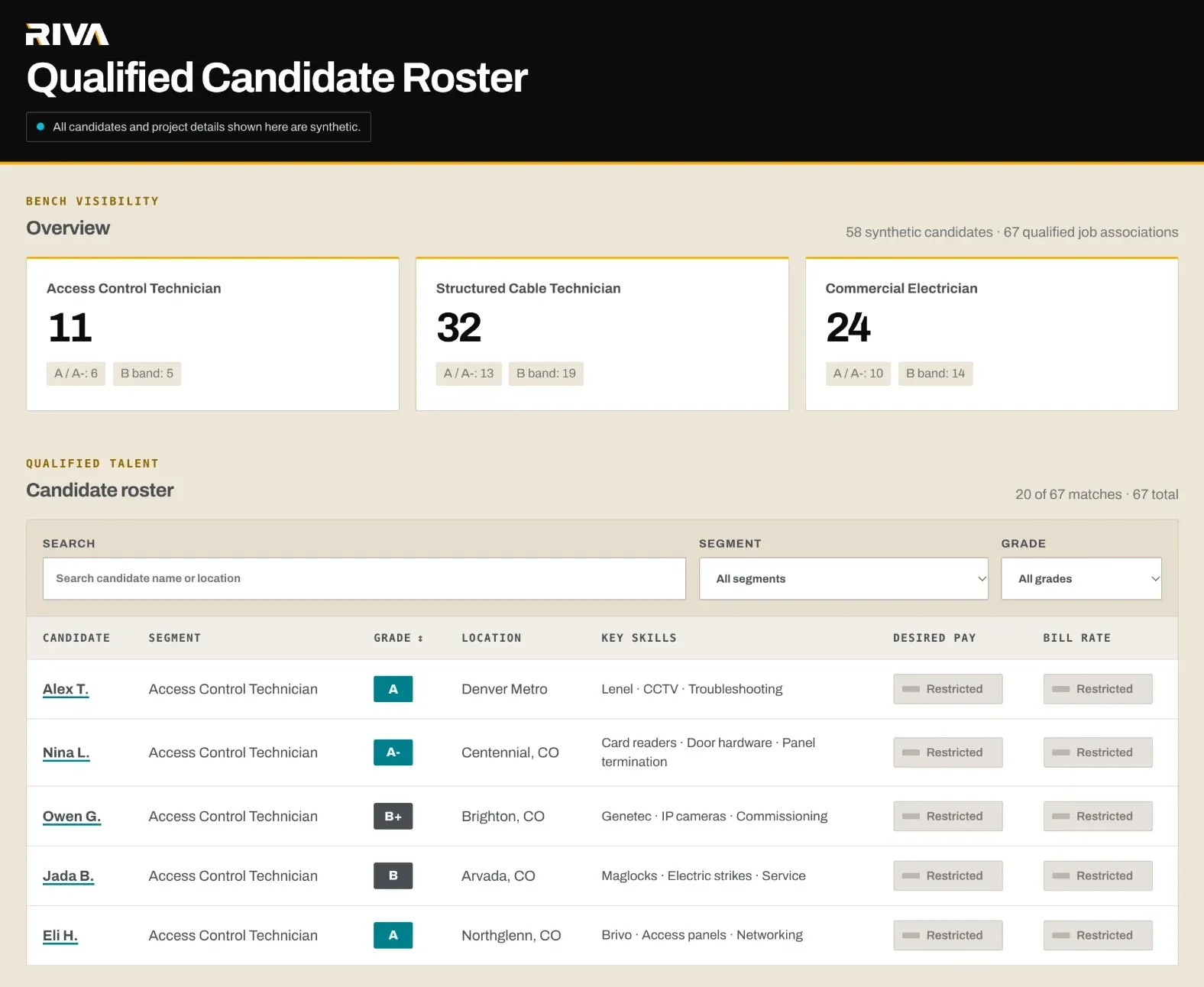
Rather than relying on disconnected notes or manually assembled candidate summaries, our team can work from a more consistent view of candidate capabilities and availability.
The same structured data powers customized, password-protected rosters for individual clients, giving hiring managers and their teams clearer visibility into candidates and the hiring pipeline.
This helps connect recruiting activity to the needs of the business.
5. Coaching the recruiter, not just evaluating the candidate
One of the most valuable opportunities emerged after we began examining the interviews themselves.
We could use AI to identify questions that weren’t asked, qualifications that needed clarification, and opportunities to explore a candidate’s experience more deeply.
Those insights inform our interview guides, evaluation criteria, and reusable recruiting skills.
The result is a feedback loop that helps recruiters improve their next conversation.
We’re not just building better candidate records. We’re building better recruiting capability.
What changed
Our AI-assisted recruiting workflow has changed both the information we capture and the effort required to organize it.
We measured the change across approximately 30–40 candidates: post-interview administration that took 30–60 minutes per candidate now takes 5–10 minutes, about 83% less time.
More importantly, we’re creating a more consistent and connected recruiting process:
- Richer, more consistent candidate information.
- Structured and searchable candidate profiles.
- More consistent evaluation criteria, with human oversight.
- Better connections between recruiting and staffing opportunities.
- Continuous recruiter coaching and improvement.
These improvements support better recruiting decisions without removing human judgment from the process.
What this demonstrates
This project began with a familiar operational problem: too much administrative work and valuable information that wasn’t being fully captured or reused.
But as we worked through the process, we discovered opportunities that went well beyond automation.
We could improve interview quality, strengthen candidate intelligence, connect information across systems, and build continuous coaching into everyday recruiting.
That’s the approach we bring to AI enablement.
We work alongside teams to understand their actual processes, co-create and test new possibilities, and build better ways of working around their expertise.
The most valuable outcome isn’t just the time saved. It’s the knowledge, judgment, and capability that continue improving long after the initial workflow is built.