
Insights · Case study · Built in Practice
From Conversation to Intelligence
How we turned everyday sales conversations into a system for business intelligence, better decisions, and continuous improvement.
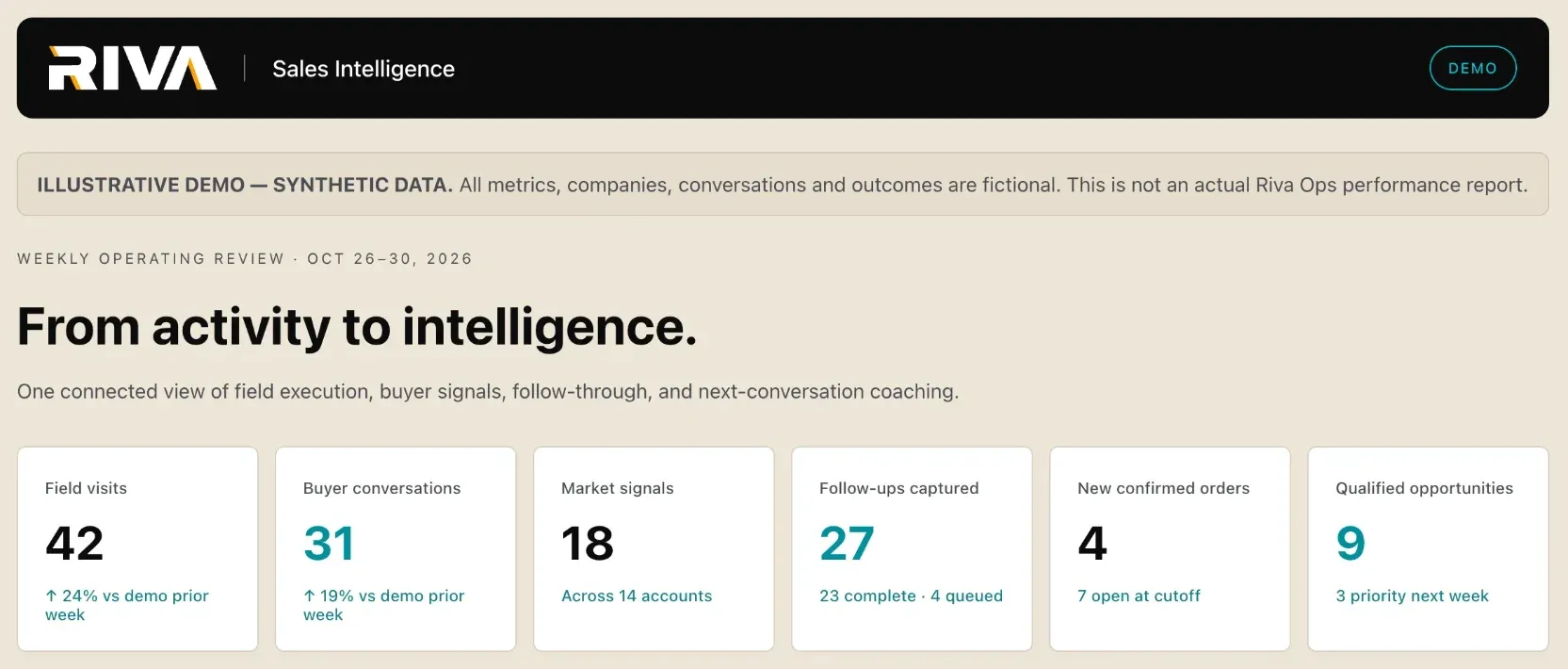
At Riva Ops, our sales process depends on face-to-face conversations with commercial contractors. Every visit is an opportunity to understand a customer’s business, identify staffing needs, build relationships, and recognize emerging demand.
But traditional sales processes leave enormous amounts of valuable information behind.
A conversation ends. Someone writes a few notes. Follow-ups get entered into a CRM, sometimes. Subtle buying signals go unnoticed. And insights from one conversation rarely inform the next.
We saw an opportunity to rethink the entire process.
What if every conversation could make the organization smarter, and every subsequent conversation more effective?
Rethinking the workflow
We didn’t start by looking for an AI tool to automate sales administration.
We started by asking what a better sales process could look like if we combined human relationships, AI, behavioral intelligence, and connected business systems.
The goal wasn’t simply to save time. It was to create a continuous learning system that would help us recognize opportunities, improve our outreach, and develop our team’s effectiveness.
That meant connecting activities that are traditionally separate: conversation capture, CRM management, follow-up, buyer intelligence, coaching, and business reporting.
What we built
We developed an AI-powered sales intelligence system that supports the entire process, from individual field visits to weekly business reviews.
Sales intelligence workflow
From Sales Conversation to Business Intelligence
A connected system that captures real conversations, turns them into insight, and drives action and continuous improvement.
- 01 Capture Sales conversations with customers and prospects.
- 02 Structure AI turns conversations into organized insights and next steps.
- 03 Detect signals Apply behavioral AI to identify buyer intent, emerging needs, and opportunities across conversations.
- 04 Activate Update the CRM, create follow-ups, and coordinate next actions.
- 05 Coach AI-powered feedback on what went well, what to try next, and how to improve.
- 06 Learn A weekly business view that turns insights into better results.
A continuous improvement loop: what we learn shapes the next conversation.
The result
From 30–60 min to 5–10 min Follow-up per sales conversation
~83% Less follow-up time per conversation
- Richer customer intelligence
- Coordinated follow-up
- A sales process that keeps improving
1. Capturing conversations and commitments
Our field conversations become structured information, including customer needs, key insights, commitments, and follow-up actions.
Rather than relying on memory or manually reconstructing every interaction, we use AI to organize the information and connect it to our CRM.
Follow-up activity aligns with our broader outreach program, helping us maintain continuity across customer relationships.
2. Recognizing behavioral signals
Drawing on our experience with behavioral AI, we’ve designed workflows that look beyond simple conversation summaries.
We identify markers that may indicate buyer intent, emerging needs, objections, or changes in customer priorities.
By examining those signals across multiple conversations, we can recognize patterns and opportunities that might otherwise remain hidden.
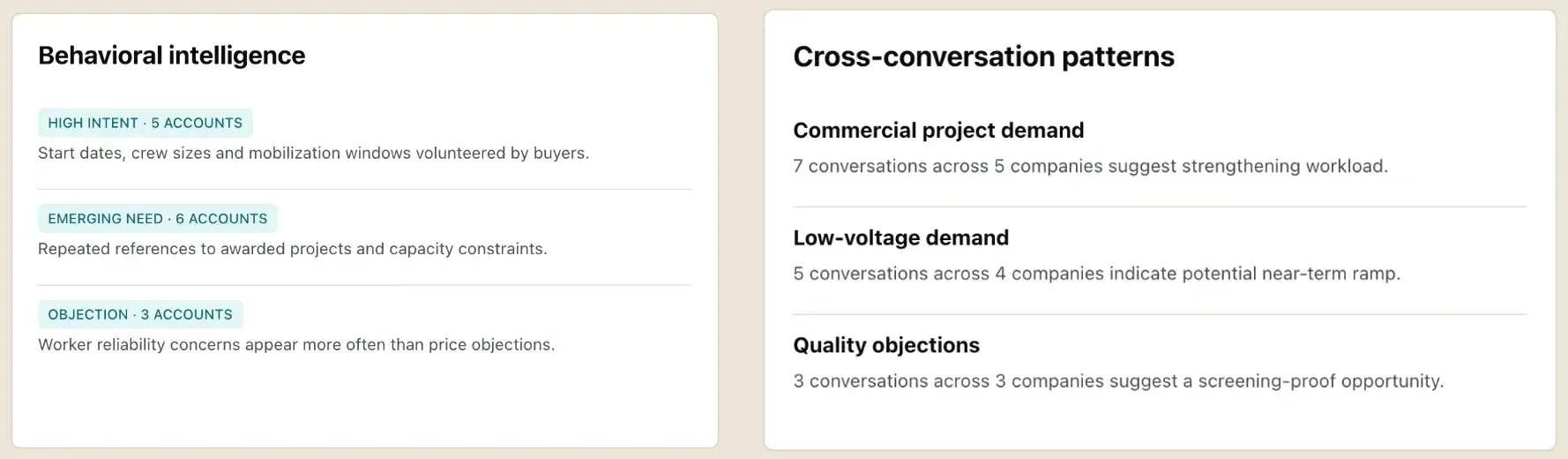
The goal isn’t to replace human judgment. It’s to give our team better information to work with.
3. Coaching the next conversation
Capturing what happened is only half the opportunity.
We also use AI to examine what didn’t happen.
What questions could we have asked? Which signals deserved more exploration? Where could we have handled an objection differently? What should we do on the next visit?
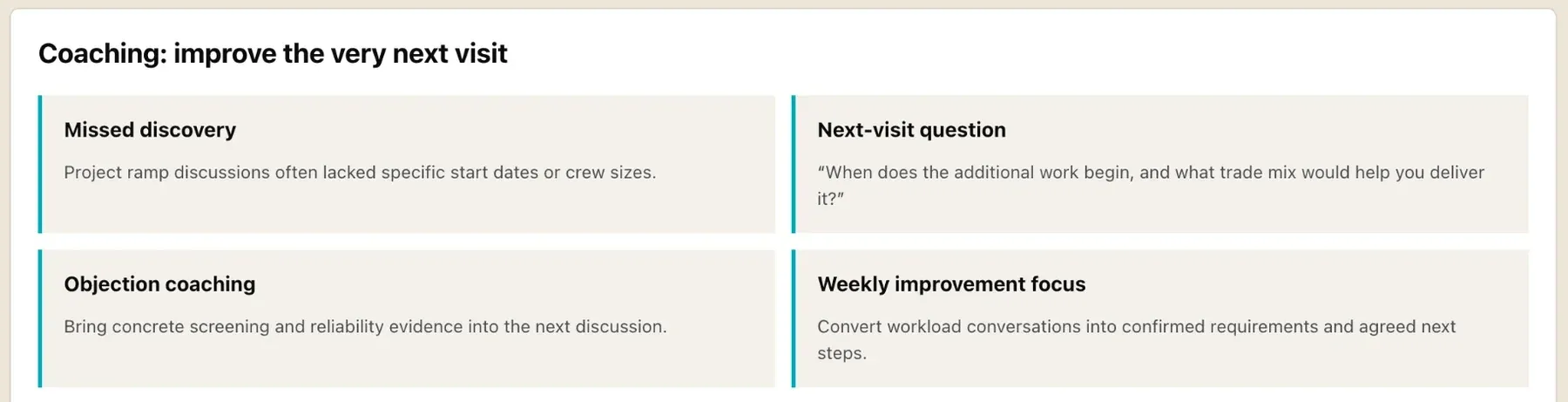
This creates an ongoing coaching process grounded in actual customer interactions.
Instead of treating training as an occasional event, we’re integrating learning directly into everyday work.
4. Connecting intelligence to business decisions
We also built a sales intelligence dashboard using AI-assisted development.
It brings together information from our sales activities throughout the week, giving us a consolidated view of customer interactions, outreach activity, emerging signals, and opportunities.
Rather than reviewing isolated CRM records, we can look across the entire sales effort to understand what’s happening and where to focus next.
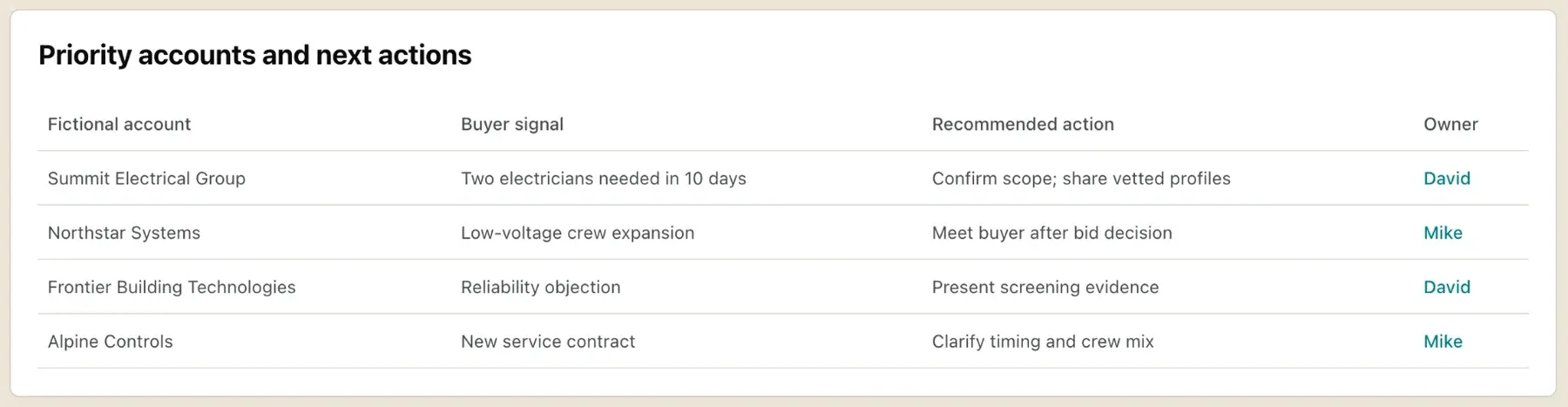
The dashboard turns accumulated information into a practical tool for weekly planning and decision-making.
What changed
We now have an operational system that connects activities that previously would have required separate processes and significant manual effort.
Conversations feed structured CRM information. Follow-up becomes part of a coordinated outreach process. Behavioral signals can be examined across interactions. Coaching helps improve the next visit. And the weekly dashboard brings the intelligence together.
We’ve measured some of the change already: follow-up that took 30–60 minutes per client now takes 5–10 minutes, about 83% less time, and route planning that took an hour or more each evening now takes minutes. We haven’t yet quantified the broader impact, but the operational change is significant.
We’ve moved from recording sales activity to building a sales process designed to learn and improve continuously.
What this demonstrates
This system didn’t begin as a predefined software product.
It evolved as we worked through real operational challenges, experimented with AI, developed reusable workflows, connected systems, and discovered new opportunities along the way.
That’s also how we approach AI enablement.
We help organizations move beyond learning individual tools to discovering, practicing, and building better ways of working.
Because the most valuable outcome isn’t simply the technology you implement.
It’s the capability your team develops to keep improving how work gets done.